Archery season opens the first weekend of October and the general whitetail season opens the first Saturday in November. Every fall, the same conversation happens: a buyer who has hunted leases for twenty years decides this is the year he stops paying somebody else for the privilege — and then discovers that a bank land loan will not close before Thanksgiving.
That is the first thing to understand about buying a hunting ranch in Texas: the season calendar and the bank calendar do not agree. The second thing is that “hunting land” covers everything from a 15-acre camp with a feeder to a 300-acre ranch you manage for trophy whitetail and free-ranging axis. Knowing which one you are actually buying is what separates a good purchase from an expensive lease with a mortgage attached.
This guide covers how much land you really need, what game is actually out there, how to judge water and habitat, what the fence line means, how the wildlife exemption pays for part of the ranch, and how to buy one — with owner financing, in days — while the season is still open.
How Much Land Do You Actually Need to Hunt?
Less than you think for a camp, more than you think for a herd.
Under 50 acres hunts as a camp. You can set a blind and a feeder, take deer and hogs that move through, and enjoy the place. But the deer are not yours — they live on the neighbors’ larger acreage and visit you. Your results depend on who is next door.
100 to 200 acres is where a ranch starts holding its own game. There is enough room for deer to bed, feed, and water on your side of the fence, enough edge and cover to carry turkey and quail, and enough separation that your management decisions (what you shoot, what you pass, what you plant) actually show up in the animals you see.
200-plus acres is where you begin managing a population rather than hunting a corner of somebody else’s. You can carry multiple blinds without pressuring the same deer, run a real supplemental feeding program, and qualify comfortably for a wildlife-management valuation.
Our two Hill Country ranches sit squarely in that middle-to-upper band: the remaining tracts at Pinto Creek Ranches run 135 to 329 acres, and the open tracts at Venado Creek Ranch run 121 to 150 acres. They were laid out as hunting ranches, not homesites.
Native Game vs. Exotics: What Is Really Out There
The western Edwards Plateau — Edwards, Kinney, Sutton, and Real counties — is some of the most game-rich country in Texas, for two reasons.
Native game. White-tailed deer are everywhere, with the Hill Country carrying some of the highest deer densities in the state. Rio Grande turkey roost in the big live oaks along the creeks. Feral hogs are abundant and have no closed season and no bag limit. Dove shooting in September is a regional tradition, and quail numbers come and go with rainfall.
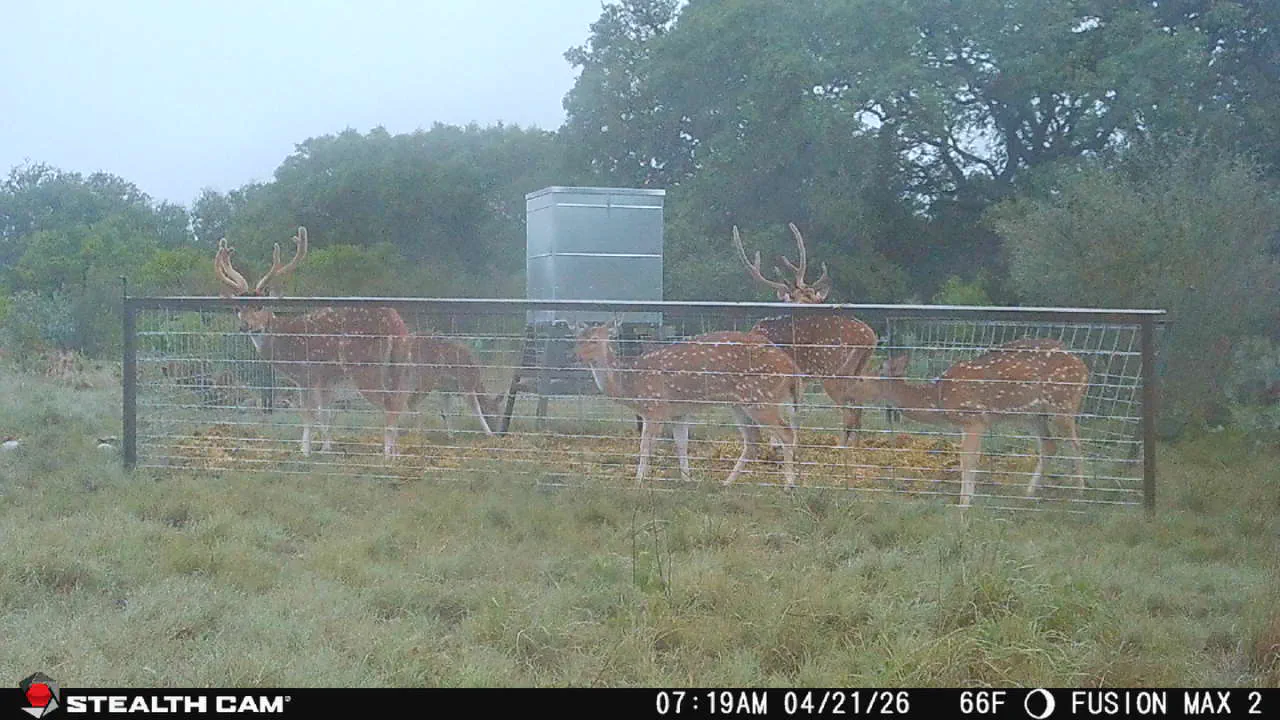
Free-ranging exotics. This is what makes the Plateau different from anywhere else in America. Axis deer, fallow deer, blackbuck antelope, and aoudad sheep escaped ranches decades ago and now roam free across the region. Texas treats exotics as livestock, not game: on private land, they carry no closed season and no bag limit (a hunting license is still required). That means a hunting ranch here is a twelve-month proposition — axis in velvet in June, aoudad in the canyons in August — not a two-month whitetail season.
Pinto Creek Ranches, in northern Kinney County, is exceptional even by Plateau standards: whitetail, axis, fallow, blackbuck, aoudad, turkey, hogs, quail, and dove on the same tracts. Venado Creek carries healthy herds of whitetail, axis, blackbuck, turkey, and hogs. Nobody stocked these animals. They are simply there.
For season dates, license requirements, and bag limits by species, see our Texas hunting seasons and regulations guide.
Water Makes the Ranch
Game goes where the water is. On a hunting ranch, water is not just a well for the cabin — it is the reason the deer are on your side of the fence at 4 p.m. in August.
Rank water sources roughly like this:
- Live water — a spring-fed creek or river frontage. Rare, valuable, and the single strongest game magnet on any tract.
- Wet-weather creeks, ponds, and stock tanks — seasonal but powerful; a tank that holds water into a dry September concentrates game all around it.
- A water well with a trough or supplemental waterer — reliable, controllable, and one of the seven qualifying practices for a wildlife exemption.
Pinto Creek Ranches takes its name honestly: This Hill Country ranch has multiple ponds, tanks, and wet-weather creeks throughout, and every remaining tract has its own water well or water well interest. Venado Creek’s open tracts each have a well or well interest and electricity already in place. Either way, you are not starting from dry ground.
If you are looking at a tract with an existing well, read our guide to buying land with a well and septic before you close — depth, yield, and the driller’s log matter as much on a hunting ranch as on a homesite.
Habitat: Live Oaks, Brush, and Edge
The best hunting ground is not the prettiest and not the roughest. It is the mix.
- Big live oaks provide mast (acorns) in the fall, shade and roost trees for turkey, and the open savanna that lets you see and shoot.
- Brush and cedar in the right amount give deer bedding cover and travel corridors. Solid cedar thickets are a liability — they crowd out grass and drink your water — but a ranch with no cover holds no deer.
- Edge — where oaks meet brush meet grass — is where game lives. A tract with variety hunts far better than a uniform one.
Both of our Hill Country ranches sit in gently rolling live-oak country that is highly usable rather than rough and rocky: Venado Creek is known for its abundance of large live oaks and minimal cedar; Pinto Creek pairs big oaks with rolling terrain and the creek bottoms that hold game. Once you own the place, our hunting property setup guide covers senderos, feeders, food plots, and blinds for your first year.
Access and Infrastructure: The Camp You Will Actually Use
A hunting ranch that takes a four-wheel-drive and forty minutes of caliche to reach gets hunted three weekends a year. One with a paved gate, power, and internet gets used every month — and holds its value accordingly.
Look for:
- Paved frontage. Every Pinto Creek tract has private, gated highway frontage on RM 674 — no dirt roads, no county-road travel, and you can pull a trailer in after a rain.
- Electricity at the tract. Both ranches have it, which means a cabin with a freezer for the meat, lights at the skinning rack, and a heater in the blind instead of a generator.
- Fiber internet. Both ranches have it, which is what turns a hunting camp into a place your family will actually spend the week — and a place you can work from on Friday before the evening sit.
- Drive time. Pinto Creek is under two hours from San Antonio; Venado Creek is about 20 minutes from Junction and an easy run from Kerrville. Close enough for a Friday-night arrival, far enough that nobody else is there.
Fences, Neighbors, and Low-Fence Reality
Much of the hunting land on the western Plateau is low-fenced, which means the deer and exotics move freely between you and your neighbors. That is a feature, not a bug — it is why a 150-acre tract can produce animals that spent most of their lives on 5,000 acres next door — but it makes your neighbors part of your management plan.
Ask who owns the adjoining ranches and how they hunt. Large, lightly hunted neighbors are the best thing that can happen to a mid-sized tract. A ranch subdivision where every tract is managed for quality, like Pinto Creek and Venado Creek, tends to produce better deer over time than an island tract surrounded by heavy pressure.
Know the fence law before you buy, too. Texas is a fence-out state in most of the Plateau, and who maintains a shared fence is a conversation to have before closing, not after. Our Texas fencing laws and livestock liability guide covers it.
Taxes: Let the Wildlife Exemption Pay for the Ranch
Here is the part most first-time ranch buyers miss. Hunting land in Texas almost always carries an agricultural (1-d-1 open-space) valuation that taxes the land on its productive value rather than market value — routinely the difference between a tax bill in the hundreds and one in the thousands.
You do not have to run livestock to keep it. Texas lets you convert an existing ag valuation to a wildlife-management valuation by filing a management plan and carrying out at least three of seven qualifying practices — habitat control, supplemental water, supplemental food, providing shelter, predator control, erosion control, and census counts. If that sounds like a description of running a hunting ranch, that is because it is. Feeders, water troughs, brush management, and an annual spotlight count qualify.
Venado Creek Ranch already carries a wildlife exemption in place, so the tax side is handled the day you close. Pinto Creek tracts carry an agricultural valuation that qualifies for the same conversion. Our Texas ag and wildlife exemption guide walks through the plan, the deadlines, and the rollback-tax trap if you let it lapse.
The Two Ranches We Would Walk First This Fall
Pinto Creek Ranches — Kinney County, near Rocksprings. The most complete hunting inventory we have ever listed. Hill Country on the southern Edwards Plateau with whitetail, axis, fallow, blackbuck, aoudad, turkey, hogs, quail, and dove. Every remaining tract has a water well or shared interest, electricity, fiber, and its own gated blacktop entrance on RM 674, with ponds, tanks, and wet-weather creeks throughout. Light covenants, no POA or HOA. Four of nine tracts are sold; five remain, from 135 acres (Tract 6, listed at $449,500 on the current pricing sheet) to the 329-acre flagship Tract 9. Read the Kinney County Land Guide.
Venado Creek Ranch — Edwards County, near Junction. Big live oaks, minimal cedar, gently rolling and highly usable, with whitetail, axis, blackbuck, turkey, and hogs. Every open tract has a well and electricity plus fiber and road frontage, and the wildlife exemption is already in place. Ten of fourteen tracts are sold; four remain, 121 to 150 acres (Tract 3, 121 acres, listed at $635,250 on the current pricing sheet). Read the Edwards County Land Guide.
Farther west near Sonora, the turnkey 463 Ranch Headquarters — 259 acres with improvements in place — is the answer for a buyer who wants to hunt opening weekend without building anything. Browse all current listings.
What It Costs to Get In — and Why You Can Still Hunt This Season
A bank land loan typically wants a large down payment, a strong credit file, an appraisal, and weeks of underwriting. On a $500,000 hunting ranch that can mean six figures down and a closing date after the season is over.
We finance our ranches directly. As little as 5% down, no credit check, terms up to 30 years, no prepayment penalty, and we typically close in days. You receive a deed at closing and we record a deed of trust securing the note — the same structure any properly run owner-financed sale uses. At 5% down, Tract 6 at Pinto Creek is roughly $22,475 to get in; Tract 3 at Venado Creek is roughly $31,763. Both numbers are less than many hunters spend on a few seasons of lease fees, and at the end you own the ranch.
Read how owner financing works in Texas, or, if a past credit issue is what has kept you leasing, read how to buy land in Texas with no credit check.
A Hunting Ranch Buyer’s Checklist
Before you sign on any Texas hunting tract, confirm:
- Game on the ground — walk it at dawn or dusk, look for tracks, rubs, and trails; ask what the ranch and its neighbors have taken
- Water — live water, tanks, and wells; the driller’s log on any existing well
- Habitat mix — oaks, cover, and edge; how much cedar and what has already been cleared
- Access and utilities — paved or caliche, electricity and fiber at the tract
- Fences and neighbors — low or high fence, who maintains it, how the adjoining ranches are hunted
- Restrictions — covenants, POA (or none), and whether hunting and blinds are expressly allowed
- Tax valuation — ag or wildlife, whether it transfers, and what it takes to keep it
- Closing timeline — whether you can actually own it before the season you are buying it for
We walk every one of these with our buyers, on the tract, usually with a rifle season on the calendar.
Frequently Asked Questions
How many acres do you need for a hunting ranch in Texas?
Around 100 acres is where a Texas tract begins holding its own deer rather than borrowing the neighbors’. Tracts of 200 acres and up let you manage a population, run multiple blinds without pressure, and qualify comfortably for a wildlife-management valuation. Smaller tracts hunt well as camps if the surrounding ranches are large and lightly hunted.
Can you hunt exotics year-round in Texas?
Yes. Texas classifies exotics such as axis, fallow, blackbuck, and aoudad as livestock rather than game, so on private land they have no closed season and no bag limit. A valid Texas hunting license is still required. Feral hogs likewise have no season or limit.
Is 100 acres enough to hunt deer in Texas?
Yes, particularly on the Edwards Plateau where deer densities are high and most land is low-fenced. A 100- to 150-acre tract with water, live oaks, and cover will hold deer and draw more from adjoining ranches, and it is large enough to run a real feeding and management program.
What is the best county in Texas for a hunting ranch?
For the combination of native whitetail and free-ranging exotics, the western Edwards Plateau — Edwards, Kinney, Sutton, and Real counties — is hard to beat. Our Pinto Creek Ranches in Kinney County carry whitetail, axis, fallow, blackbuck, aoudad, turkey, hogs, quail, and dove on the same tracts.
Can I get a wildlife exemption on a hunting ranch?
Yes, if the land currently carries an agricultural valuation. You file a wildlife management plan and carry out at least three of seven qualifying practices — supplemental water, feeders, brush management, and census counts all count. Venado Creek Ranch already has a wildlife exemption in place.
Can I buy a Texas hunting ranch with owner financing and no credit check?
Yes. Texas Land Brokerage finances its ranches directly with as little as 5% down, no credit check, terms up to 30 years, and no prepayment penalty, and typically closes in days — which means you can own the ranch before the general whitetail season opens.
Ready to Hunt Your Own Ground This Season?
The season is open and the ranches are still here — for now. Browse the remaining tracts at Pinto Creek Ranches and Venado Creek Ranch, see our full Texas land listings, or contact us to schedule a showing. We will walk the creeks, the oaks, and the fence lines with you and get you to closing before opening day.
Texas Land Brokerage specializes in Texas land sales with owner financing — 5% down, no credit check, terms up to 30 years. Browse properties at texaslandbrokerage.com.